
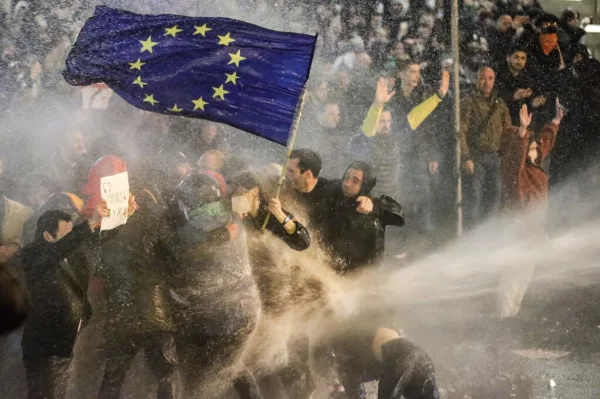
Mass protests flooded the streets of Tbilisi, the capital of Georgia, in response to the so-called “Foreign Influence” bill on March 7. The ruling Georgian Dream party passed the initial reading of the draft law, triggering clashes between protesters and law enforcement. According to the bill, any non-governmental organization and media outlet that is funded more than 20 percent by foreign powers is instructed to register as “agents of foreign influence.” Non-fulfillment could lead to serious fines. Protestors stated that the passing of the bill was an attempt by the Georgian government to move closer to Moscow and away from the west.
Anti-Russian response as a result of the bill
Given Georgia’s history as part of the former Soviet Union and a short Russian invasion of Georgia in 2008, anti-Russian sentiment is strong. Thousands of protesters carried European Union (EU), Georgian and Ukrainian flags through the streets of Tbilisi in opposition to the “Foreign Influence” bill, chanting: “No to the Russian law! No to Russian government in Georgia!” After two days of mass protests and violent clashes with law enforcement (who used water cannons and tear gas to disperse the crowds), the Georgian Dream party announced it would withdraw the bill.
Although Georgia’s French-born president, Salome Zourabichvili, was supported by the Georgian Dream during her candidacy in 2018, she stated that the draft law “[looks] like Russian politics” and should be fought to continue Georgia’s path to EU candidacy. With her vow to veto the draft bill, President Zourabichvili fully broke from her former backers.
Conflicting beliefs about the inspiration for the law
The Georgian government maintained that the bill was inspired by an American law of 1938, encouraging greater transparency in regard to foreign funding. Georgian protestors, however, believe that the law was actually based on a 2012 law in Russia, which has been employed to fight against political opposition and reduce the influence of NGOs and media funded by the west. As such, the controversial legislation has also been referred to as the “Russian law” bill.
Protestors argue that the law would suppress the press’ freedom of speech and impede upon Georgia’s process of becoming a candidate for European Union (EU) membership. On March 3, 2022, a week after Russia’s invasion of Ukraine, Georgia applied for EU membership. The EU rejected this application in June, but awarded Georgia a “European perspective” status, keeping the door open for future candidacy. The opinion of the European Commission stated that while Georgia has the foundations to achieve candidacy status, a number of steps need to be taken for the criteria for candidacy can be met.
The international response
EU representatives warned that the “Foreign Influence” bill defied the 12 priorities that are required to gain candidacy status for the EU. Additionally, Human Rights Watch stated the bill would be “incompatible with international human rights law.”
Although it was already announced that the Georgian Dream Party would withdraw the draft law, members of the Georgian opposition encouraged further protests until the more than 100 protesters that were detained would be released. As a result, several thousand people gathered again on the evening of March 9, leading to the release of the 133 protestors soon after.
Cover image by: Agence France-Presse – Getty Images, retrieved from the New York Times
Views of this article